
Parade Candy Chaos
An 8-bit Fourth of July game dreamed up by my 9-year-old daughter, inspired by our small-town parade in Chassell, Michigan.

Parade Candy Chaos: An 8-Bit Fourth of July Game Built With My 9-Year-Old
Play the game: https://kdgodfrey.itch.io/parade-candy-chaos
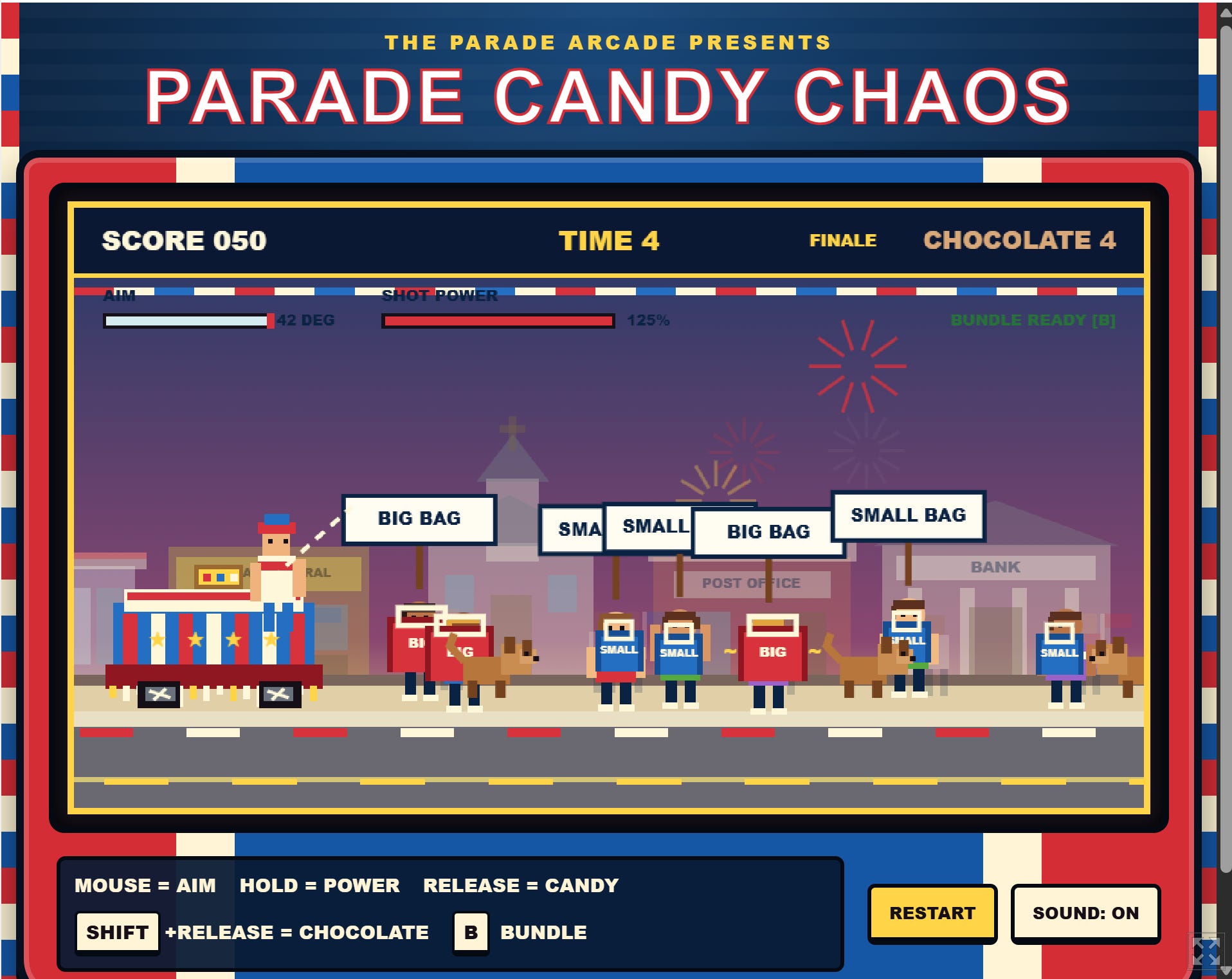
I built a tiny 8-bit browser game called Parade Candy Chaos, but the most important thing to know is that this was not just my idea.
This was a team project with my 9-year-old daughter, Ade.
The whole game concept was hers.
She came up with the idea of a Fourth of July parade game where you ride on a float and throw candy to kids, trying to get it into their bags. She also came up with the most important rule:
Chocolate should be worth more points, but dogs might jump up and eat it.
That one idea became the entire heart of the game.
The idea
Parade Candy Chaos is based on our small town, Chassell, Michigan, and the kind of Fourth of July parade Ade and I actually know.
Kids line up on the side of the road with bags. Floats roll by. People throw candy. Everyone is trying to get the good stuff. There is always a marching band somewhere nearby. And if there is a dog around, the dog is absolutely going to make things more complicated.
Ade’s version turned that into a game:
Throw candy into the bags.
Chocolate is worth more.
Do not let the dog get it.
Simple. Funny. Perfect.
How it plays
In the game, you ride on a traditional parade float and throw candy into kids’ bags as the parade moves through town.
Regular candy is safe.
Chocolate is worth more.
But the dog is watching.
If the dog sees chocolate, he might jump in and intercept it. If he gets it, you lose points and he has a very dramatic little cartoon puke moment.
It is silly, it is chaotic, and it immediately made the game more fun.
The game loop
The parade float moves down the road past different kids holding candy bags.
Some bags are big and easier to hit. Some are small and worth more. You aim, charge your throw, and try to land candy in the bags while the parade keeps moving.
There are also a few parade problems:
Dogs trying to steal chocolate
A marching band blocking your throws
Fireworks during the finale
Moving kids and bags
Candy bundles that can score big
Chocolate hidden inside some bundles
Streak bonuses for good aim
Dog warning tells and funny whiffs
The final stretch turns into fireworks chaos mode, where the points are higher, but the dog penalties are worse too.
The town
The game is based on Chassell, our small town in the Upper Peninsula.
I did not want the background to feel like a random arcade street. I wanted it to feel familiar.
So the parade route passes little pixel-art versions of places that feel like home, including:
Our local Krist gas station
The Dollar General
A small-town church
The post office
The bank
Sidewalk crowds
Red, white, and blue parade decorations
It is not meant to be a perfect map of Chassell. It is more like a tiny 8-bit love letter to a small-town Fourth of July parade: familiar buildings, kids with bags, a float rolling by, fireworks coming, and one dog creating unnecessary problems.
Ade’s role
Ade was the creative director of this game in the most real sense.
She had the original idea.
She knew how it should work.
She had strong opinions about what was fun, what was boring, what looked weird, and what needed to change.
A lot of the best parts came directly from her:
Throwing candy into kids’ bags
Chocolate being worth more points
Dogs trying to steal the chocolate
The game feeling like a real parade
The whole thing being silly instead of serious
My job was to help turn her idea into something playable.
How AI helped
I used AI as a build partner, not as the source of the idea.
Ade came up with the game.
Then I used ChatGPT and Codex to help turn it into a real browser game.
The process looked something like this:
Ade came up with the concept.
We talked through how the game should work.
I used ChatGPT to shape the idea into a game design plan.
I used Codex to help build and revise the code.
We playtested it and kept fixing what felt off.
The game went through several versions:
V1 was the basic candy-throwing game.
V2 added the Chassell-inspired background, marching band audio, moving targets, and candy bundles.
V3 made the float actually move through the parade instead of staying in one place.
V4 added mouse aiming, hold-to-charge throwing, clearer text, and stronger dog pressure.
V5 became the “make it feel fun” pass, with better hit feedback, streaks, fairer dog behavior, bundle scoring, and a stronger end screen.
A lot of the iteration came from normal playtesting complaints:
The signs looked weird.
The kids needed to be cuter.
The float needed to feel more like a real parade float.
The dog was too unfair.
The game needed to feel more like the float was moving down the road.
Good hits needed to feel more satisfying.
That was where AI was most useful. It helped turn messy feedback into clear design notes and code changes.
But the weird little human idea was still the best part.
Built to stay small
This is a simple static browser game.
No backend.
No package install.
No framework.
No external art assets.
Just HTML, CSS, JavaScript, Canvas, code-generated pixel graphics, and browser audio.
You can open it in a browser and play a 60-second round.
That constraint was part of the charm. I wanted it to feel like a tiny cartridge game someone might have made because they were thinking about parades, candy, dogs, fireworks, and America’s birthday.
Why we made it
I love the Fourth of July.
Ade loves funny game ideas.
This became a perfect little project for both of us.
It has the things we wanted:
A Chassell-inspired small-town parade
Candy
Kids with bags
A marching band
Fireworks
A decorative parade float
A dog causing problems
Just enough chaos to make it funny
It is not trying to be deep.
It is a tiny 8-bit game about throwing parade candy.
But it does have one very important lesson:
Protect the chocolate.
Aim for the bag.
Never trust the dog.
"The children demand another lap" LOL